
A way for communities to govern their own research, data, and resources.
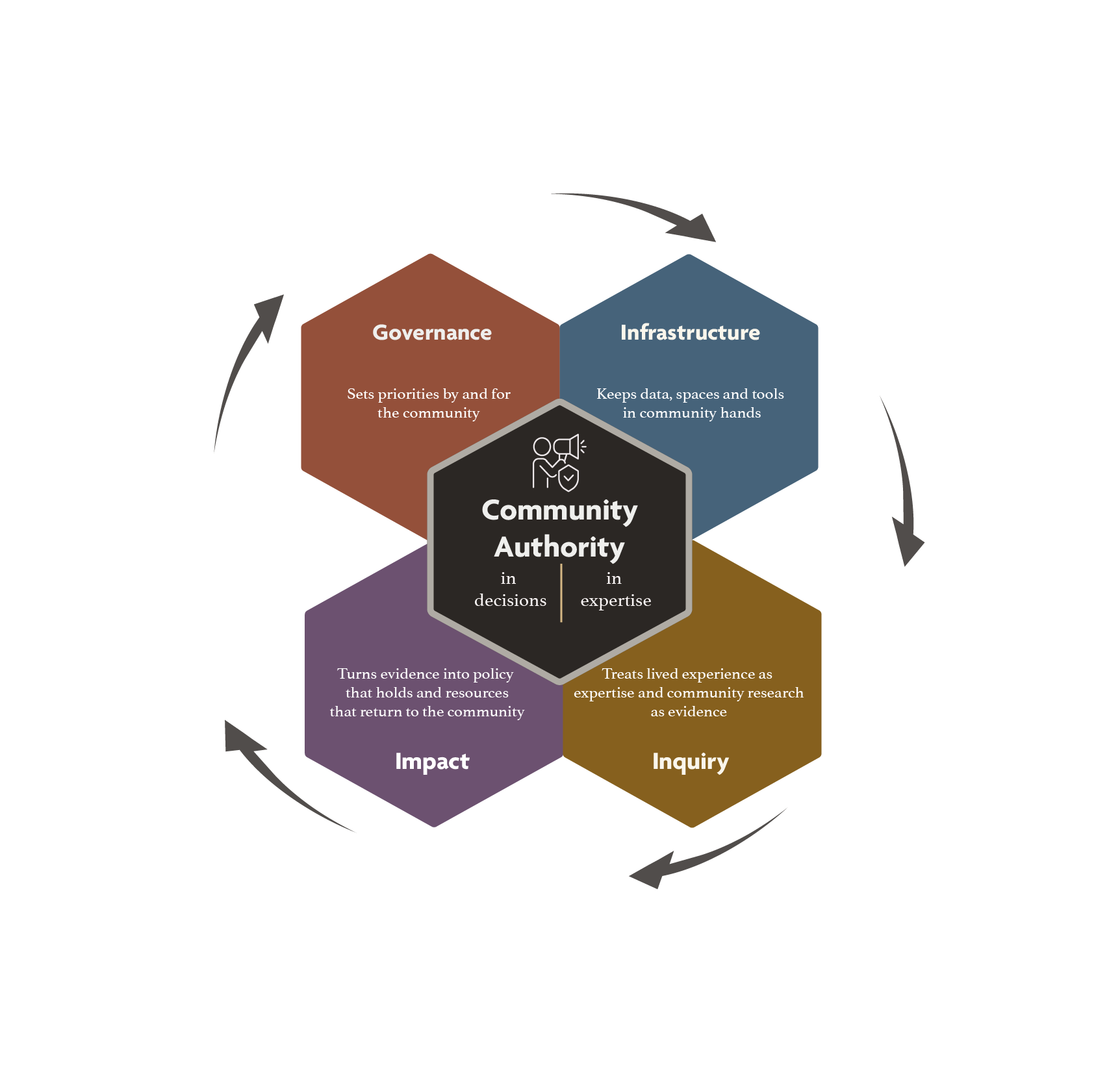
The people closest to a problem understand it best. The Hive Model gives them binding authority over what gets studied, how their data is used, and what change looks like. Institutions and funders stay at the table, in a supporting seat.
Why we built it
Communities give their stories, their data, and their time. What comes back is usually a program designed on their behalf. The Hive changes who gets to name what's real.
Four pillars
Everything is organized around community authority.
Governance
A decision-making body where the people affected hold at least 51 percent of the votes. Its decisions on data, research, and money are binding.
Infrastructure
A trusted home base and seven decision rights that cover community data from the moment it is collected to the day a partnership ends.
Inquiry
Research questions set by the community. Residents and frontline staff are trained and paid as researchers. Findings stay in a commons the community owns.
Impact
Findings carried into policy and funding without losing what the community meant. Wins are checked afterward to see whether they lasted.
How a decision moves
Define. Validate. Deploy.
Three jobs, held by three different groups. No one holds more than one. That separation keeps a good idea from being reshaped on its way to action.
Authors define
People with lived stakes in the issue name the problem and what change should look like. They hold the voting majority.
Translators validate
Practitioners and researchers put it into institutional language and check that the meaning survived.
Anchors deploy
Institutions and funders carry the decision into budgets and policy, then report back on what moved. Their seats are advisory.
Where it lives
A Hub and its Nodes
The Hub
A place people already use and trust, like a library, a community center, or a college. It hosts the governing body, a dedicated room, and the shared equipment and network.
The Nodes
Community organizations, clinics, schools, and other frontline groups. They run the research, try things out, and write down what they learn. Knowledge moves between them, and no single site keeps it to itself.
In a Hive, community means any group of people who experience something together. A neighborhood counts. So do students, officers, or the staff of one organization. Hives can nest, so a high school can be its own Hive inside a citywide one.
How a community gets there
A first pilot, start to finish
We call it the smallest viable Hive: one community, one trusted host, and every pillar working at a size people can manage.
Find the convener
A community organization people already trust brings everyone together. When an institution starts the process, its first act is handing that role over.
Seat the body and set up the Hub
A charter written with the community. The Author majority confirmed before the first vote. A room, a network, and named owners for each data decision.
Ask the first questions
The body approves research questions before any data is collected. Residents and frontline staff do the research.
Name the change
The community picks a target and writes down, in advance, what would count as the win slipping.
Carry it and check it
Anchors take the validated findings into policy and funding. The body watches whether the result lasts, and resources return to the Hub.
Hand it over
We build to transfer. The community decides when it is ready to run the Hive without us, on its own timeline.
The evidence
None of these practices are new. The arrangement is.
Each pillar rests on work with a documented track record. What the Hive adds is a different answer to who holds authority over it.
Binding community decisions
Participatory budgeting began in Porto Alegre, Brazil in 1989 and has spread to more than 7,000 cities. In Brazil's largest cities it was associated with more health spending, more civil society organizations, and lower infant mortality, and the association grew the longer a program stayed in place.
Touchton and Wampler, 2014; Participatory Budgeting Project
Trusted places and community data rights
In a 2017 Pew survey, 78 percent of U.S. adults said they trust information from public libraries at least somewhat. The seven decision rights descend from the CARE Principles for Indigenous Data Governance and the First Nations Principles of OCAP.
Pew Research Center, 2017; Carroll et al., 2020; FNIGC
Communities as researchers
Community-based participatory research has decades of evidence behind it. A 2023 systematic review of trials with disadvantaged communities found that 14 of 36 engagement programs reached shared leadership, the highest level measured.
Wallerstein et al., 2018; Riccardi et al., 2023
Power that turns into policy
The California Endowment's ten-year Building Healthy Communities initiative invested in community capacity. Its evaluation connected that investment to more than 1,700 policy, systems, and environmental accomplishments.
Center for Outcomes Research and Education, 2022
Where the evidence is still thin. Research linking community power directly to health outcomes is young and largely conceptual, and strong evaluations of participatory budgeting outside Brazil are scarce. A pilot Hive is partly a way to add to that record. (NASEM, 2022; Campbell et al., 2018)
For the full evidence base and reference list, ask us for the Hive Model document →
Where you come in
We are looking for the first Hive.
Community organizations
If people name your organization when asked who shows up, you may be the convener a Hive starts with.
Funders
A Hive needs standing investment that keeps the structure in place between grants, and project money for work the community has defined. Community members are paid in both.
Institutions and researchers
Libraries, colleges, agencies, and universities join as hosts and Anchors. You bring access and resources, and you enter on terms the community sets.
Say hello
Know a community that's ready?
Or a funder, a library, a college. We'd like to hear about it, even if it's early.